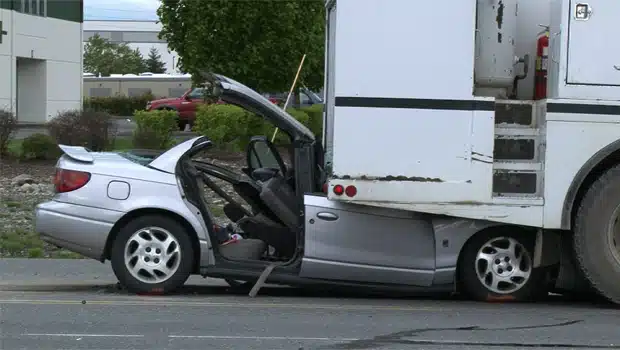
A passenger vehicle collides with the rear of an 18-wheeler on a Texas highway, sliding beneath the trailer instead of striking its protective bumper. The resulting injuries might be substantially more severe than those associated with an ordinary rear-end collision. Federal regulations establish specific requirements for trailer underride guards, but determining legal responsibility requires examining the equipment’s condition, the collision’s cause, and whether a safety failure contributed to the injuries.
Why Truck Underride Accidents Cause Severe Injuries
An underride collision occurs when a smaller vehicle travels beneath a larger truck or trailer during an impact. According to the National Highway Traffic Safety Administration, these crashes create substantial risks because the trailer’s structure might enter the passenger compartment.
Rear underride guards are designed to engage the smaller vehicle and reduce dangerous passenger compartment intrusion. However, the presence of a guard does not guarantee protection in every collision. Impact speed, vehicle alignment, and equipment performance influence the severity of the resulting injuries.
Federal Law Establishes Rear Guard Requirements
Under 49 CFR Section 393.86, most trailers and semitrailers manufactured on or after January 26, 1998, with gross vehicle weight ratings of at least 10,000 pounds must have qualifying rear impact guards.
The regulation establishes specific measurements:
- Guard width: The horizontal member must extend within four inches of the trailer’s sides.
- Ground clearance: The guard’s bottom edge generally cannot exceed 22 inches above the ground.
- Rear positioning: The guard must satisfy requirements concerning its distance from the trailer’s rear extremity.
Specified trailer categories receive exemptions. The trailer’s manufacture date, configuration, and regulatory classification determine which requirements apply.
A 2026 Federal Rule Changed Labeling Requirements
On February 19, 2026, the Federal Motor Carrier Safety Administration published a final rule concerning rear impact guard certification labels. Effective March 23, 2026, the amendment eliminated the motor-carrier regulation requiring permanent certification labels under Section 393.86(a)(6).
However, the amendment did not eliminate federal guard strength, positioning, or performance requirements. Manufacturer certification requirements under Federal Motor Vehicle Safety Standard No. 223 remain separate.
A missing certification label does not automatically establish that a trailer violates federal safety standards. Investigators must examine the equipment’s actual condition and compliance.
Driver Negligence and Equipment Failure Are Separate Issues
A truck might become involved in a collision because its driver brakes unexpectedly, changes lanes dangerously, or fails to display functioning warning lights. However, defective rear protection creates another question concerning the severity of the resulting injuries.
An 18-wheeler accident lawyer in Texas investigating these collisions examines whether driver conduct caused the initial impact and whether inadequate underride protection contributed to the injuries. Martin Law Firm, operating through Bad Crash, handles serious commercial truck collision claims throughout Texas.
Legal Texas’s discussion of commercial truck accident liability explains why responsibility sometimes extends beyond the driver.
Causing a collision and contributing to the severity of the injuries are distinct legal questions.
Manufacturers and Maintenance Companies Face Different Claims
49 CFR Section 396.3 requires motor carriers to systematically inspect, repair, and maintain commercial vehicles. Maintenance records generally must be retained for one year and for six months after a vehicle leaves the carrier’s control.
A damaged underride guard might raise questions about inadequate inspections or repairs. However, a guard allegedly defective when manufactured presents a different legal theory.
Under Texas Civil Practice and Remedies Code Section 82.005, a design-defect claim requires proof of a safer alternative design and that the defect was a producing cause of the injury.
A regulatory violation and a legally actionable product defect are not automatically interchangeable findings.
Physical Evidence Establishes How the Guard Performed
Accident investigators examine guard deformation, attachment points, vehicle damage, impact angles, and maintenance documentation. These materials help determine whether the guard complied with federal requirements and whether its condition affected the collision’s consequences.
Legal Texas’s guide to steps after a truck accident emphasizes preserving photographs, witness information, and commercial vehicle records.
Repairing or replacing a damaged underride guard before documenting its condition risks destroying important physical evidence. Engineering analysis also helps distinguish equipment failure from forces exceeding the guard’s intended protective capabilities.
Texas Fault Rules and Filing Deadlines Apply
Under Texas Civil Practice and Remedies Code Section 33.001, claimants generally cannot recover damages when their responsibility exceeds 50%. Section 33.003 requires responsibility to be allocated among qualifying parties based on their contribution to the harm.
Additionally, Section 16.003 generally establishes a two-year limitation period for personal injury lawsuits, subject to exceptions.
An underride collision does not automatically establish that a trucking company or equipment manufacturer is liable. The decisive evidence concerns whether negligent driving, inadequate maintenance, or defective equipment caused the crash or increased the injuries. Establishing those connections requires preserving the trailer and reconstructing the collision before critical evidence is altered or lost.
This article provides general legal information and is not individualized legal advice.