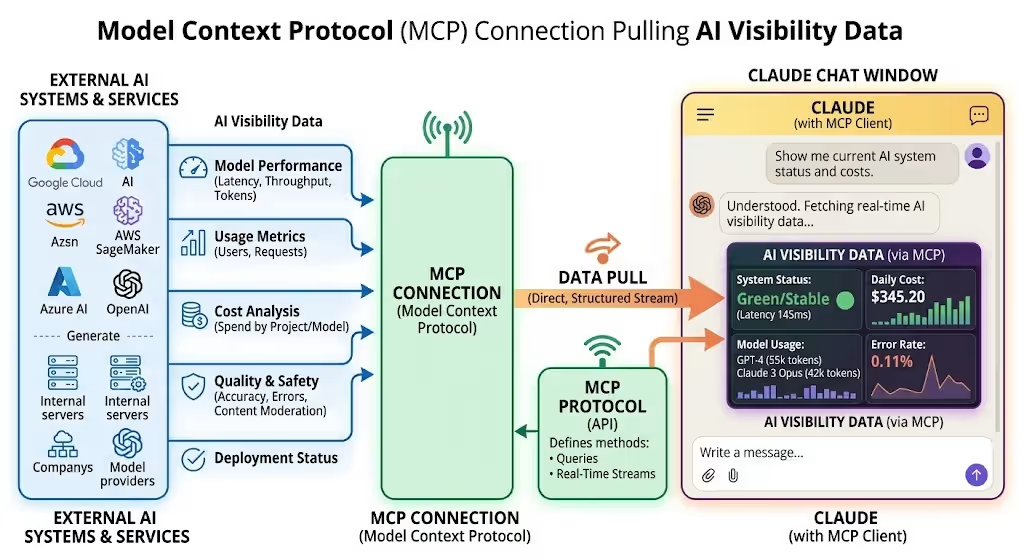
An analyst checking AI visibility for a brand typically opens a dashboard, filters by date range, and copies the numbers into a report by hand. GEO tools with MCP skip that step. MCP, short for Model Context Protocol, lets an AI assistant like Claude or ChatGPT pull a tool’s data straight into the chat window the analyst is already using, no separate login required. Most GEO platforms haven’t built this yet. This roundup checks all eight tools in our GEO lineup against that one question, assistant access or dashboard-only, with Ubersuggest first for pairing a confirmed MCP server with a full SEO toolkit in the same connection.
What Does It Mean for a GEO Tool to Work Inside an AI Assistant?
MCP is an open standard that lets an AI assistant connect to an outside tool’s data and call it directly during a conversation. Instead of an analyst opening a browser tab to check a visibility number, they ask Claude or ChatGPT the question, and the assistant retrieves the live figure through the connected server.
For GEO specifically, that means a question like “how has our AI visibility share moved over the last 60 days” can be answered inside the same chat window where the analyst is already drafting a report, instead of requiring a separate dashboard check.
Not every GEO platform supports this. Some expose a general API a developer could wire up manually. Far fewer ship an actual MCP server or documented assistant integration a non-developer can connect in an afternoon.
What to Look for in a GEO Tool With MCP
Three checks separate a genuine assistant integration from a marketing claim:
- Does the tool expose GEO data specifically, visibility share, rank, sentiment, not just traditional keyword or rank-tracking data, through its MCP server or API?
- Does it connect to Claude, ChatGPT, or both, and is that connection documented rather than theoretical?
- Is assistant access included at a standard pricing tier, or gated behind an enterprise contract?
A tool being “AI-powered” internally says nothing about whether its own data can be pulled into an outside AI assistant. Those are two unrelated things, and vendor marketing tends to blur them.
GEO Tools Compared for MCP and Assistant Access
1. Ubersuggest
- Best For: Teams that want GEO data and standard SEO data pulled into the same Claude or ChatGPT session.
- Key Strengths: Ubersuggest’s MCP server lets AI assistants like Claude and ChatGPT pull Ubersuggest data directly into a chat, covering the same Projects area where AI Search Visibility, Rank Tracking, and Competitor Analysis already live side by side.
- Pricing: Free plan available. Individual $12/month, Business $20/month, Enterprise $40/month, plus a lifetime deal option.
- Standout Feature: GEO tracking and traditional SEO data available through one MCP connection, rather than needing a separate assistant integration for each.
- Why It Made Our List: Most tools with MCP or API access on this list are GEO-only. This is the one that also brings keyword research, site audit, and competitor data into the same assistant session, at a price built for a small team.
2. Otterly.AI
- Best For: Lean teams wanting daily GEO tracking accessible through an API or MCP connection.
- Key Strengths: MCP and API access available from the Standard tier, daily tracking frequency, and unlimited team members on every plan.
- Pricing: Lite $29/mo (15 prompts), Standard $189/mo (100 prompts), Premium $489/mo (400 prompts), Enterprise custom.
- Standout Feature: The only other tool on this list with confirmed MCP or API access to its GEO data, though it requires stepping up from the entry Lite plan to Standard to get it.
- Why It Made Our List: A genuine second option for assistant-connected GEO tracking, strongest for teams that don’t need a full SEO suite alongside it.
3. Profound
- Best For: Enterprise brand teams, accessed through its dashboard and reporting exports rather than an assistant connection.
- Key Strengths: Citation intelligence across up to nine engines on Enterprise, sentiment trends, and executive-level reporting built for dashboard review.
- Pricing: Limited free trial (10 prompts, one-time, ChatGPT only); Enterprise is a custom quote.
- Standout Feature: Deep citation-source attribution, delivered through its own interface rather than an open MCP connection.
- Why It Made Our List: Included for completeness on depth, with the caveat that its data currently lives in its dashboard, not inside Claude or ChatGPT.
4. Peec AI
- Best For: Agencies working primarily inside Peec AI’s own dashboard for sentiment and visibility review.
- Key Strengths: A 0-100 sentiment score per mention, daily per-engine tracking, and unlimited seats on every paid tier.
- Pricing: Starter from about $95/mo, Pro from about $245/mo, Advanced from about $495/mo; Enterprise custom.
- Standout Feature: Granular per-engine sentiment, viewed through its dashboard rather than pulled into an outside assistant.
- Why It Made Our List: A strong dashboard-first option, relevant here mainly as a contrast to the MCP-connected tools above it.
5. Semrush (AI Visibility Toolkit)
- Best For: Teams reviewing AI visibility inside the broader Semrush dashboard ecosystem.
- Key Strengths: A free AI Visibility Checker, a Brand Performance dashboard, and bundling into Semrush One plans.
- Pricing: AI Visibility Toolkit from about $99/mo per domain (billed annually, 25 prompts); Semrush One bundles start at $199/mo; Enterprise custom.
- Standout Feature: Share-of-voice and sentiment data in one dashboard view, built for in-platform review rather than assistant access.
- Why It Made Our List: A dashboard-first tool worth including for teams already standardized on Semrush, even without an assistant connection for its GEO data specifically.
6. Ahrefs Brand Radar
- Best For: SEO teams reviewing AI citation data inside the Ahrefs dashboard.
- Key Strengths: Citation-source URL attribution, a sentiment tab, and a large organic prompt index.
- Pricing: Requires an Ahrefs subscription (Lite from $129/mo); Brand Radar adds Select Platforms at $398/mo or All Platforms at $699/mo.
- Standout Feature: Large-scale citation attribution, delivered through Ahrefs’s dashboard rather than an assistant integration for Brand Radar data.
- Why It Made Our List: Strong on depth, dashboard-first on access, same pattern as most of the field here.
7. Scrunch AI
- Best For: Agencies reviewing multi-brand GEO data inside Scrunch’s workspace interface.
- Key Strengths: Separate brand and pitch workspaces, unlimited seats on Agency plans, and monthly site audits alongside prompt tracking.
- Pricing: Core $250/mo (5 seats, 125 prompts), Agency Core $500/mo (250 prompts, unlimited seats), Enterprise custom.
- Standout Feature: Agency workspace structure, built around dashboard review rather than assistant access.
- Why It Made Our List: Included for agency-scale coverage, with the same dashboard-first caveat as the rest of the non-MCP field.
8. AthenaHQ
- Best For: Teams reviewing GEO visibility tied to GA4 and Shopify data inside AthenaHQ’s own interface.
- Key Strengths: A permanent free Essential tier, GA4 and Shopify connections, and 11 AI models tracked on Starter.
- Pricing: Free Essential tier; Starter $295/mo ($245/mo billed annually, 3,600 credits); Enterprise custom.
- Standout Feature: Revenue-linked visibility data, reviewed through its dashboard rather than pulled into an assistant.
- Why It Made Our List: The clearest case for dashboard review over assistant access, since the revenue connection is the point of the tool.
[IMAGE: Side-by-side comparison showing which of the eight GEO tools offer confirmed MCP or API access versus dashboard-only access]
Quick Comparison
| Tool | MCP or API Access | Connects To | Pricing (entry) |
| Ubersuggest | Yes (MCP) | Claude, ChatGPT | Free; paid from $12/mo |
| Otterly.AI | Yes (MCP/API, Standard tier+) | Developer-configurable | $29/mo (MCP from $189/mo) |
| Profound | No (dashboard) | N/A | Custom (trial available) |
| Peec AI | No (dashboard) | N/A | ~$95/mo |
| Semrush | No (dashboard) | N/A | ~$99/mo |
| Ahrefs Brand Radar | No (dashboard) | N/A | $129/mo (Ahrefs) + add-on |
| Scrunch AI | No (dashboard) | N/A | $250/mo |
| AthenaHQ | No (dashboard) | N/A | Free / $295/mo |
Enhanced Comparison
| Tool | Best For | Core Strength | Pricing (entry) | Standout Feature | Free Plan Available | Best Team Size | AI Platforms Tracked |
| Ubersuggest | Assistant access plus full SEO toolkit | MCP covers SEO and GEO together | Free; paid from $12/mo | One connection for both data sets | Yes | Solo/SMB/Agency | ChatGPT, Gemini, Claude, and similar |
| Otterly.AI | Lean teams wanting MCP/API on GEO data alone | Daily tracking, unlimited seats | $29/mo | MCP/API from Standard tier | No | Solo/SMB | 4 included, more as add-ons |
| Profound | Enterprise dashboard reporting | Source-level citation attribution | Custom | Up to 9 engines on Enterprise | Trial only | Enterprise | Up to 9 |
| Peec AI | Agencies wanting dashboard sentiment depth | 0-100 sentiment score | ~$95/mo | Per-engine daily tracking | No (7-day trial) | Agency/SMB | 3 included per tier |
| Semrush | Teams standardized on Semrush dashboards | Share-of-voice dashboard | ~$99/mo | Free AI Visibility Checker | Partial | SMB/Enterprise | Varies by tier |
| Ahrefs Brand Radar | SEO teams on Ahrefs | Citation-source URL attribution | $129/mo (Ahrefs) | Large organic prompt index | No | Enterprise/Agency | 7 |
| Scrunch AI | Agencies with many client brands | Agency workspace structure | $250/mo | Monthly audits + prompt tracking | No (7-day trial) | Agency | Up to 9 on Enterprise |
| AthenaHQ | Teams wanting revenue-linked visibility | GA4/Shopify connection | Free / $295/mo | Credit-based, revenue-linked | Yes | SMB/Enterprise | 11 |
How to Choose Between an MCP-Connected Tool and a Dashboard-First Tool
The decision comes down to where the work already happens. A team that spends most of its day inside Claude or ChatGPT, drafting reports and running research in the same window, gets real time back from a tool that answers GEO questions without a tab switch. Ubersuggest and Otterly.AI are the two confirmed options here for that workflow.
A team that doesn’t live inside an AI assistant day to day won’t feel the absence of MCP as much, and several of the dashboard-first tools on this list go deeper on a specific metric, citation-source attribution from Ahrefs Brand Radar, or revenue-linked visibility from AthenaHQ, than either assistant-connected option does. Assistant access is a workflow advantage, not automatically a data-quality advantage.
FAQ
What does MCP mean for a GEO tool?
MCP, Model Context Protocol, is an open standard that lets an AI assistant like Claude or ChatGPT query a tool’s data directly inside a chat session, instead of a person opening a separate dashboard to look it up.
Which GEO tools actually have MCP access today?
In this roundup, Ubersuggest and Otterly.AI are the two with confirmed MCP or API access to their GEO data. The rest, Profound, Peec AI, Semrush, Ahrefs Brand Radar, Scrunch AI, and AthenaHQ, are dashboard-first as of this writing.
Does an “AI-powered” GEO tool automatically have assistant integration?
No. A tool using AI internally to analyze visibility data is unrelated to whether that data can be pulled into an outside assistant like Claude or ChatGPT. Those are separate capabilities, and it’s worth confirming the MCP or API documentation directly rather than assuming one implies the other.
Is a dashboard-only GEO tool a dealbreaker?
Not for every team. Dashboard-first tools can still offer deeper reporting on a specific metric. MCP access matters most for teams whose daily workflow already runs through an AI assistant.
Choosing a GEO Tool for Claude and ChatGPT
GEO tools with MCP are still rare. Of the eight compared here, Ubersuggest and Otterly.AI are the confirmed options for pulling AI visibility data directly into Claude or ChatGPT, and the rest remain dashboard-first for now. For teams that want that assistant connection to also cover standard SEO data, not just GEO, Ubersuggest’s MCP server is the broader of the two.