You file your application, pay the fees, and follow every instruction. Then you wait. Weeks turn into months. Sometimes, you wait for years.
Maybe you are waiting for a green card. Maybe your family petition is still pending. Or maybe you need a decision before you can move forward with work, travel, or family plans.
So, what can you do when USCIS takes too long?
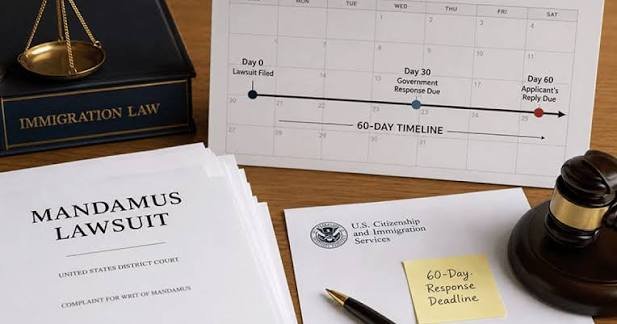
A mandamus lawsuit may be one option. It allows you to ask a federal court to require USCIS to act on an unreasonably delayed immigration case.
Table of Contents
- What Is a Mandamus Lawsuit?
- When Can You Actually File a Mandamus?
- How to Process a Mandamus Lawsuit
- What Mandamus Can (and Can’t)
- FAQs
- Final Words
What Is a Mandamus Lawsuit?
A writ of mandamus is a court order. It tells a government agency to do something it’s already legally required to do.
USCIS and other immigration agencies have a duty to process applications. When they sit on a case for far longer than normal, applicants can ask a federal court to step in.
Here’s what matters most:
- Mandamus lawsuits are filed in federal district court, not immigration court.
- The lawsuit doesn’t ask a judge to approve your case.
- It asks the judge to order USCIS to decide your case, one way or another.
When Can You Actually File a Mandamus?
Not every slow case qualifies for mandamus relief. Courts expect a few boxes checked first.
You generally need:
- Pending appeal with the United States Citizenship and Immigration Services (USCIS) or another federal agency
- Proof that the agency has a clear duty to act on your case
- Evidence that the delay has gone on longer than what’s reasonable
Timing matters too. Delays beyond standard processing times are the first red flag courts look for. Mandamus lawsuits can be filed after a 180-day delay in many situations, though every case is judged on its own facts.
Before heading to court, individuals must exhaust administrative remedies before filing a mandamus lawsuit. That usually means following up with USCIS, checking your case status, and giving the agency a fair shot to respond first.
If your case fits this pattern, working with an attorney who handles Mandamus lawsuit filings can help you figure out whether the timing is right and whether your evidence of hardship holds up in federal litigation.
How to Process a Mandamus Lawsuit
Filing a mandamus action isn’t a one-click process. It follows a set path through the federal court system.
| Step | What Happens |
| Case review | Mandamus lawyers check your file for unreasonable delay and a clear legal duty. |
| Complaint drafted | A formal complaint is written and filed in the correct federal district court. |
| Government served | USCIS and the Department of Justice are formally notified. |
| Government response | The government has 60 days to respond after being served in a mandamus lawsuit. |
| Outcome | USCIS often adjudicates the case, or the court orders a decision. |
In many cases, USCIS may transfer cases to expedite processing after a mandamus filing, rather than fight it in court. Petitioners must show a clear legal right to the action requested. That’s the legal backbone of the whole case. Alongside it, a petitioner must show tangible hardship caused by the delay, such as lost job opportunities, separated families, or expired documents.
What Mandamus Can (and Can’t)
A mandamus lawsuit can:
- Compel USCIS to make a decision
- Push a stalled case back onto someone’s desk
- Force a response after months (or years) of silence
A mandamus lawsuit cannot:
- Guarantee your application gets approved
- Force a specific outcome from an agency
- Skip you ahead of the actual legal requirements
Mandamus litigation can’t compel a specific outcome from an agency. It just forces a decision, whether yes or no.
This is where working with an experienced immigration attorney actually pays off. Hacking Immigration Law, LLC handles cases like this. The firm works with families and individuals stuck in USCIS backlogs, building the kind of documented, court-ready case that gets results instead of getting tossed out on a technicality.
FAQs
Do I need a lawyer to file immigration appeals?
You’re not legally required to have one, but federal litigation has strict rules, and a mistake in the complaint or the filing venue can get your case dismissed before it’s even heard.
Will filing a mandamus lawsuit make USCIS deny my case out of spite?
No. Courts don’t allow retaliation, and in practice, most agencies simply adjudicate the case to close it out rather than escalate the dispute.
How long does a mandamus take from filing to resolution?
It varies, but many cases resolve within a few months once the government’s 60-day response window passes, especially if USCIS decides to act rather than litigate.
Final Words
Waiting on a stalled immigration case is exhausting, and for a while, patience feels like the only option. But when delays stretch past what’s reasonable, a mandamus lawsuit gives you a real legal path forward.
If your case has been sitting for months with no movement, don’t just keep refreshing the USCIS portal. Talk to someone who knows how mandamus actually works.