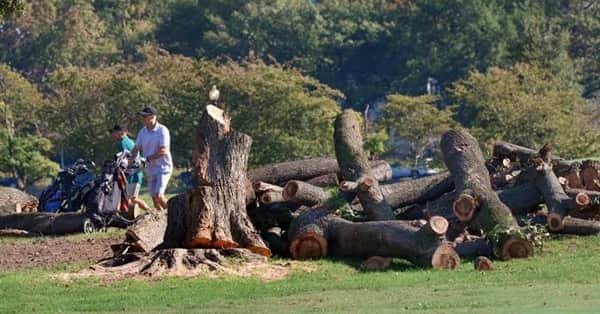
Hundreds of trees were cut down at East Potomac Golf Links in Washington, D.C., over a single October weekend, even as federal officials faced a lawsuit over the public course’s future. The rapid clearing brought an emergency hearing, sharp criticism from a federal judge and a temporary order stopping further removals. It also intensified a larger conflict over President Donald Trump’s plan to replace the historic municipal golf layout with a championship-style course.
As of October 23, 2026, the litigation remains active. The dispute is about more than whether a golf course needs repairs. Plaintiffs question the government’s legal authority and environmental review, while the administration says work on the site is permissible and disputes the connection between the recent clearing and the president’s redesign proposal.
How the Lawsuit Began
East Potomac Golf Links occupies federally managed parkland near the National Mall. The public course has a long recreational history and offers a different experience from private, high-end golf facilities.
In February 2026, the D.C. Preservation League and two golfers sued the Department of the Interior and National Park Service in federal district court. The case, DC Preservation League v. Department of Interior, No. 1:26-cv-00477, challenges federal actions linked to plans for the property.
One central question is whether the proposed redevelopment requires formal agency decisions and reviews under laws including the Administrative Procedure Act and National Environmental Policy Act. The government has argued that a broader renovation concept was not yet a final agency action subject to the challenges asserted by the plaintiffs.
The October 10 Tree-Cutting Operation
According to U.S. District Judge Ana C. Reyes’s October 13 memorandum opinion, the Interior Department directed and approved a tree-management plan between October 5 and October 9. Crews then began cutting trees on October 10 and removed approximately 430 healthy, non-invasive trees before rain interrupted additional work.
Federal officials maintained that the operation implemented vegetation recommendations contained in a 2019 cultural landscape report. Plaintiffs argued the rapid clearing was linked to the proposed championship redesign and should not proceed without the required review.
The scale and speed of removal became central to the court’s response. Trees cannot simply be restored if the agency eventually loses the lawsuit, making the injury potentially irreversible.
What Judge Ana Reyes Ordered
On October 13, Judge Reyes granted emergency temporary relief. The order barred further tree removal through October 26 and required three business days’ advance notice before irreversible alterations to permanent features of the course during the order’s term.
The court found, at this preliminary stage, that plaintiffs had shown a likelihood of success on important jurisdictional and environmental-review questions. In particular, the opinion identified problems with the agency’s examination of environmental consequences and concluded that felling additional trees risked irreparable harm.
A temporary restraining order is not a final victory on every claim. It preserves conditions while the court evaluates the dispute. The court still must determine whether longer-lasting relief is appropriate and how the challenged agency actions should be assessed.
Trump’s Renovation Announcement Added New Tension
On October 18, President Trump said the course would close from November 15 for a roughly 15-month renovation and posted a redesign concept involving architect Tom Fazio. He characterized the existing facility as deteriorated and envisioned a course suitable for major tournaments.
The public announcement complicated the government’s position in court that there had been no final decision implementing the redesign. Officials continued to distinguish the tree work from a completed renovation decision, while plaintiffs argued the developments were part of a connected effort to reshape the site.
Following a lengthy October 19 hearing, the judge had not issued a final ruling on the plaintiffs’ request for a preliminary injunction, according to reporting available by October 23. The Justice Department had also requested that Judge Reyes step aside, but reports said she declined to recuse herself at that hearing.
The Legal Questions Still Before the Court
The case involves several distinct questions: whether the relevant government actions can be reviewed now; whether officials complied with environmental procedures; whether the course’s historic and public uses received proper consideration; and whether further work should be blocked while those claims are litigated.
Frequently Asked Questions
Q. Did the judge order the government to replant the 430 trees?
The October 13 emergency order stopped additional cutting; it was not a final order requiring replacement of every tree already removed.
Q. Can the announced November 15 renovation start despite the lawsuit?
The administration announced that date, but the project faces unresolved legal challenges. Its ability to proceed depends on subsequent court rulings and lawful agency decisions.
Q. Does the restraining order close East Potomac Golf Links to golfers?
The reported order targets tree removal and irreversible changes. It should not be treated as a general judicial closure order for all recreational use.