It isn’t illegal to talk to a dolphin, at least not in the way the claim sounds. No US law bans speaking, whistling, or waving at a dolphin. What the law does prohibit is harassing wild dolphins, which can include approaching, chasing, feeding, touching, or swimming with them. The “talking to dolphins” claim is a viral exaggeration of those protections. The real rules are strict, though, and tourists and boaters have been fined for violating them.
The Law Behind the Claim: The Marine Mammal Protection Act
The main law is the Marine Mammal Protection Act (MMPA), passed in 1972 to protect marine mammals from harm caused by human activity. It prohibits the “take” of any marine mammal, a term that goes well beyond hunting. Under the MMPA, “take” means to harass, hunt, capture, or kill a marine mammal, or to attempt to do so.
The definition of harassment is where most people get caught. Harassment is any act of pursuit, torment, or annoyance that could injure a wild marine mammal or disturb it by disrupting behaviors such as migration, breathing, nursing, breeding, feeding, or sheltering. A dolphin doesn’t have to be hurt for a violation to occur. Disturbing its normal behavior can be enough.
The Hawaii Rule That Fueled the Rumors
Much of the confusion comes from a 2021 federal rule for Hawaiian spinner dolphins. The swim-with and approach prohibitions apply in waters within 2 nautical miles of the Hawaiian Islands. The rule prohibits people and vessels from coming within 50 yards of a spinner dolphin. The rule is a specific application of the MMPA’s harassment ban. News coverage of tourists being cited under it spread online, and the story turned into the broader claim that dolphin interaction is illegal.
The rule includes exceptions. If you inadvertently come within 50 yards or a dolphin approaches you, you must make no effort to engage or pursue it and must move away.
Why the Law Protects Dolphins This Way
The restrictions exist because close human contact can harm wild dolphins even when people mean well. Hawaiian spinner dolphins feed offshore at night and return to the coast during the day to rest. Repeated approaches by swimmers and boats can interrupt that rest and make it harder for them to recover and feed. Regulators also point to other problems:
- Feeding can make dolphins dependent on humans and draw them toward boats and fishing gear, where they can be injured.
- Chasing or surrounding animals can separate mothers from calves or force dolphins to flee.
- Close contact can be dangerous for people too, since dolphins are large wild animals that can bite or strike.
Penalties and Enforcement
These rules are enforced. Officers have issued penalties to swimmers under the MMPA’s penalty policy, which also applies to commercial operators, and a dolphin tour operator in Hawaii was fined in 2017 for harassing spinner dolphins. In one widely reported case, authorities accused 33 swimmers of violating the 50-yard rule.
Penalties can be civil or criminal. Civil penalties can reach tens of thousands of dollars per violation after inflation adjustments, and knowing violations can carry criminal fines and up to a year in jail under the statute. Boats, vessels, and gear can also be affected. The actual outcome depends on the facts and the agency’s penalty policy.
What You Can Still Do
The law doesn’t stop people from enjoying dolphins responsibly:
- Watch from a distance. Viewing wild spinner dolphins from at least 50 yards away is allowed under the rule. Following that distance guideline is a good practice for other wild dolphins as well.
- Speak or cheer from a legal distance. Making noise from a boat at a safe distance isn’t the legal issue. Approaching or disturbing the animals is.
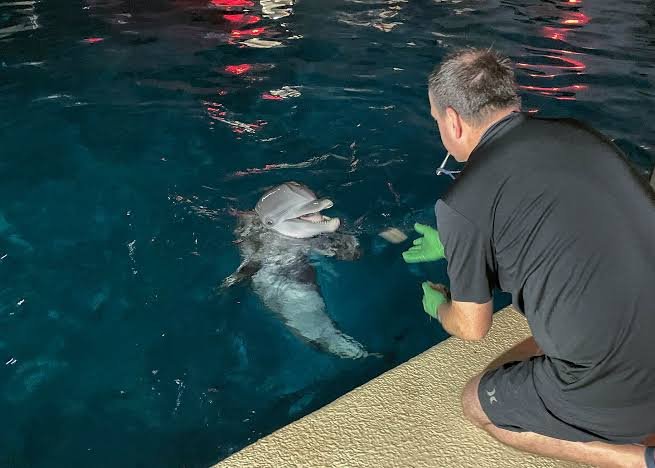
- Visit licensed facilities. Interacting with dolphins at an aquarium or marine park is generally legal, since those facilities operate under separate federal permits and animal welfare rules.
- Go on a responsible tour. Dolphin SMART guidelines encourage staying at least 50 yards away, putting your engine in neutral when dolphins are near, and refraining from feeding, touching, or swimming with wild dolphins.
If You Spot an Injured or Harassed Dolphin
Don’t try to help the animal yourself. Keep your distance and report the situation to NOAA Fisheries or your local marine mammal stranding network. In Hawaii, the Hawaii Marine Animal Response hotline is (888) 256-9840.
The Bottom Line
Talking to a dolphin isn’t illegal in the US, but chasing, feeding, touching, or swimming with wild dolphins can be a federal violation under the Marine Mammal Protection Act. In Hawaii, a specific 50-yard rule applies to spinner dolphins. If you want to see dolphins, keep your distance, let the animals decide whether to approach, and if they do, move away calmly.