An X-LITE terminal spears a vehicle. The road reopens. Within days, relevant evidence sits scattered across separate systems. Crews haul the damaged hardware away. A tow truck takes the car. Skid marks wash out. Photographs taken in the first hours can outlast all of it.
Some scene evidence changes within hours. Records held by agencies or medical providers take separate written requests. This guide walks through steps to take after x-lite guardrail impalement incidents so the material survives, and so preservation never gets confused with proof of liability.
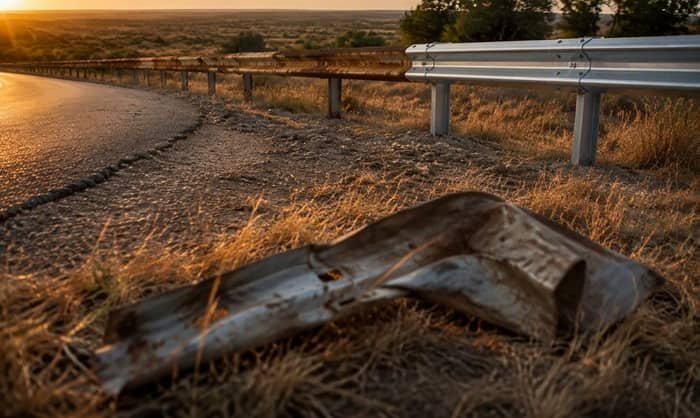
Why Evidence Can Disappear After an X-LITE Guardrail Crash
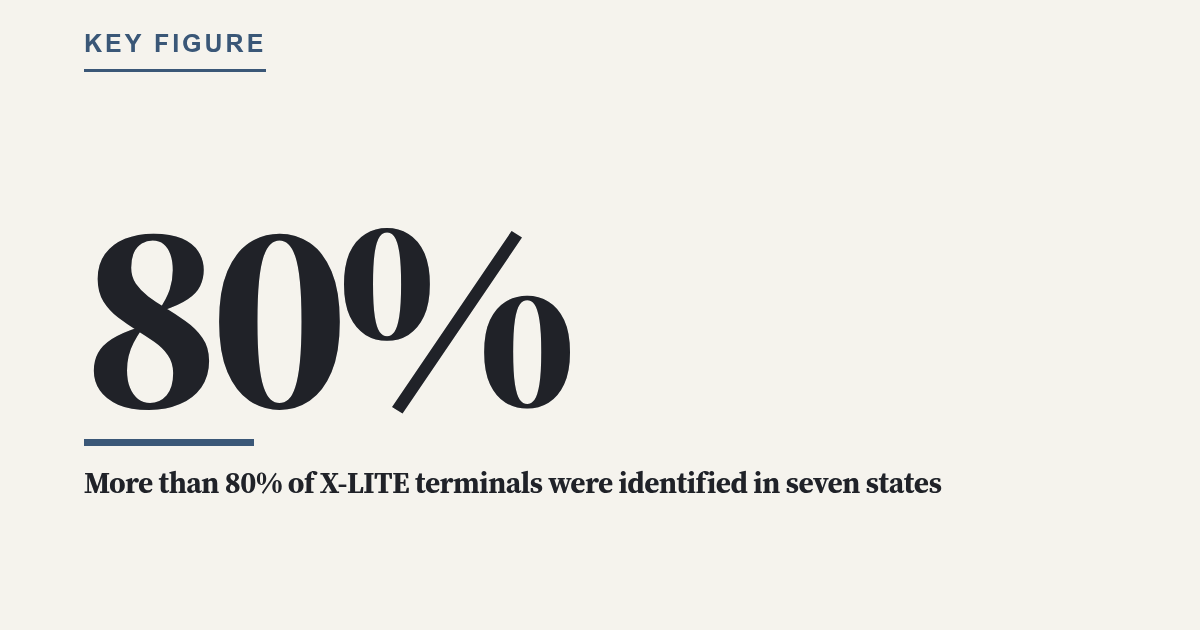
The X-LITE has a documented Texas footprint. In 2017, the Federal Highway Administration found more than 80% of the roughly 14,000 X-LITE terminals identified nationwide in seven states, Texas among them. That figure is historical, not a current installation count. It explains why the model matters to Texas drivers.
A terminal is the assembly at the end of a guardrail, the part meant to absorb an impact instead of letting the rail become a spear. Once a terminal takes a hit, transportation crews pull the damaged hardware so the roadside is safe again. Pieces get separated or thrown out, and nobody records where each one sat. By then the vehicle could already sit in an insurer’s storage yard or salvage lot, waiting for auction.
The scene itself decays. Rain softens skid marks and gouges, passing traffic scatters debris and erases tire tracks. Dashcam and surveillance files overwrite on loops. Traffic-camera and dispatch recordings disappear on their holders’ retention schedules. Even cooperative witnesses lose fine details within weeks.
The hardware is one thing; the evidence of its original position is something separate. A photo taken before removal shows the terminal’s orientation long after its parts land in separate bins.
What Are the Correct Steps to Take Immediately After the Collision?
Handle injuries and traffic danger before everything else. Notify law enforcement where Texas Transportation Code Chapter 550 requires it, pin down where the vehicle is headed, and document visible conditions from a safe spot only.
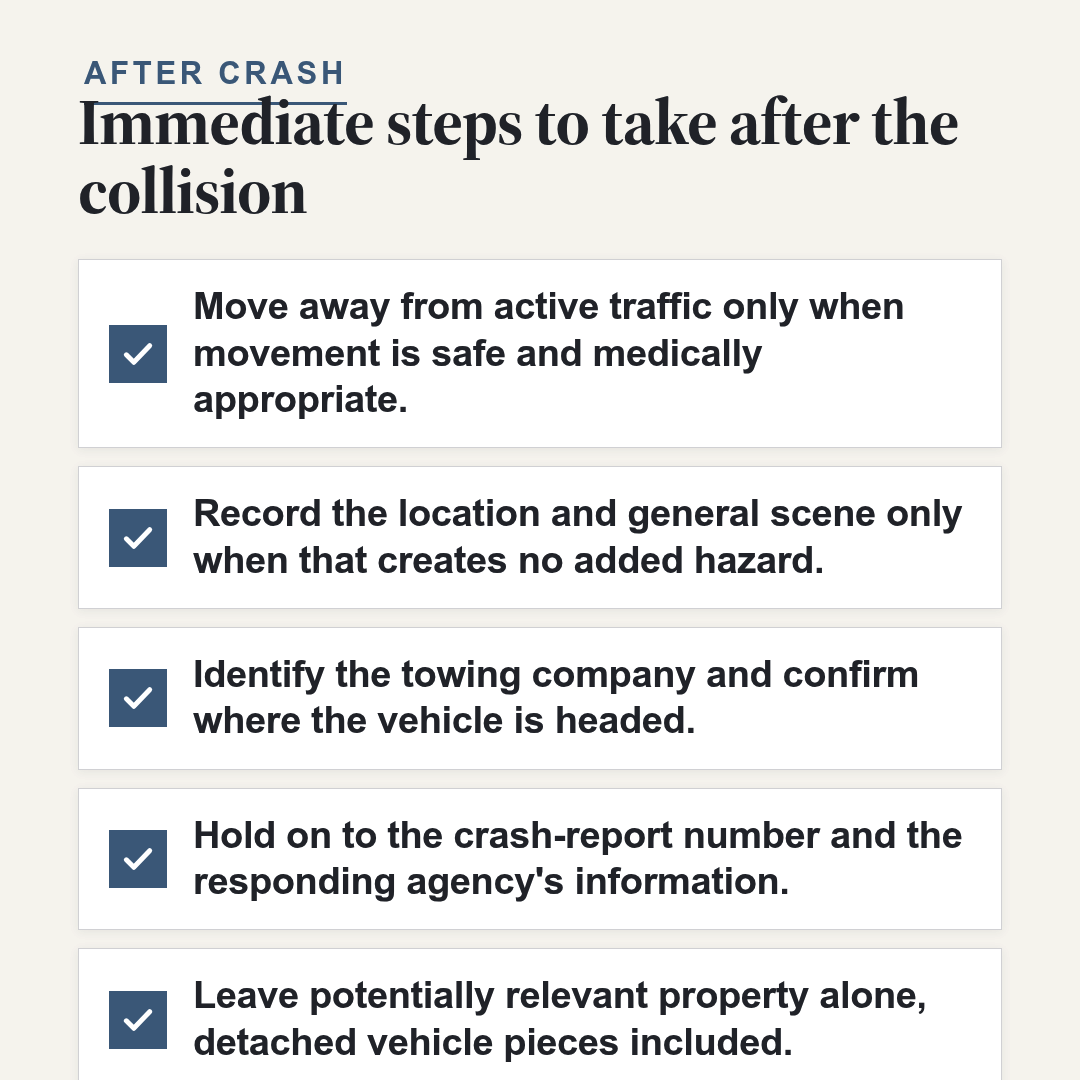
- Check for injuries and call for emergency help. Tell the dispatcher about trapped occupants and immediate traffic hazards.
- Move away from active traffic only when movement is safe and medically appropriate.
- Notify law enforcement immediately if someone is injured or killed, or vehicle damage prevents normal and safe driving. Chapter 550 imposes its own notification duties for damaged highway property.
- Record the location and general scene only when that creates no added hazard.
- Identify the towing company and confirm where the vehicle is headed.
- Hold on to the crash-report number and the responding agency’s information.
- Leave potentially relevant property alone, detached vehicle pieces included.
Safety comes before any photograph. Do not step into traffic or climb barriers for a shot. Never handle sharp metal or delay treatment to gather details. A family member or other lawful observer can document visible conditions from a safe public location.
How Soon Should Guardrail Evidence Be Photographed?
As soon as you can do it safely and lawfully, and preferably before towing or repairs change the scene. Weather and ordinary traffic keep altering visible conditions after you leave. “Immediately” never means entering a closed roadway or getting in the way of emergency personnel.
No scene photos? Write down the vehicle’s storage location and identify the road authority. The crash report is still obtainable, and you can still request existing recordings. A business near the crash site may hold footage even after the cleanup ends.
Keep the originals. A screenshot or social-media copy does not count. Skip filters, markup, cropping, and compression. Back the files up without deleting them from the first device, and write down who took each photo and when.
Metadata, the information stored inside a digital file, sometimes holds capture details worth keeping: an image’s date and time, plus location data if the device recorded it.
What Evidence Should Be Photographed After a Guardrail Impalement?
Deciding what evidence to photograph after a guardrail impalement starts with context before close-ups. Photograph the roadway approach and shoulder, lane markings, nearby signs, curves, slopes, lighting conditions, and the vehicle’s final position when it is safely visible.
Then the hardware itself. Photograph the terminal’s impact head and adjoining rail sections. Include posts, the anchor area, bent or separated components, and the direction of intrusion into the vehicle. Never move a piece for a cleaner shot.
Visible labels and serial or model markings can help a qualified reviewer identify the system. Photograph fasteners and the post arrangement without entering an unsafe area. Leave physical measurements that need roadway access to properly equipped professionals.
Photograph every accessible side of the vehicle before repairs or salvage operations alter it. Document the impact point, the intrusion path, visible cabin damage, deployed restraints, tires, and detached pieces.
Record temporary conditions when they are present: construction devices or vegetation, standing water or damaged signs, and fresh roadway work. Describe what the images show. Do not claim a condition caused the crash.
Do not disturb the scene.
Preservation steps to take after x-lite guardrail impalement
Several unrelated entities can hold relevant material. The road authority or a maintenance contractor controls the terminal. A towing company or repair facility holds the vehicle; an insurer or lender decides its next stop. Hospitals keep medical records, and law-enforcement agencies hold reports and some recordings.
| Evidence | Why It May Change or Disappear | Possible Controller | Preservation Focus |
|---|---|---|---|
| Terminal hardware | Removal or repair; disposal or separation of components | Road authority or maintenance contractor | Identify the agency; record location and condition before removal |
| Damaged vehicle | Repair or auction; salvage or crushing | Owner or insurer; towing company or salvage yard | Confirm storage location and request that it remain unaltered |
| Scene conditions | Weather or traffic; cleanup or roadway work | No single controller | Preserve dated photographs and video; retain safely obtained measurements and location data |
| Digital recordings | Routine deletion or overwriting | Agency or business; vehicle owner or device owner | Identify the recording source and request retention promptly |
| Medical documentation | Records may be split across providers | Hospital or physician; imaging center or rehabilitation provider | Keep provider names and service dates; retain imaging and discharge materials |
| Witness information | Contact details and memory may be lost | Individual witnesses | Retain names and contact details alongside the circumstances of observation |
One Texas firm has walked through this exact situation. Fibich, Leebron, Copeland & Briggs lays out steps to take after an X-LITE guardrail impalement in a guide covering protection of the vehicle and terminal hardware, scene documentation, medical records, and the parties most likely to control evidence. Their core point is worth repeating: preservation allows later examination; it does not by itself prove a product defect or an installation failure.
Do not assume someone else secured the material. Identify each holder and send a written preservation request specifying what must remain intact, unaltered, and protected from disposal. Include the crash date and location. Keep any response confirming the storage address, and ask about scheduled transfers or disposal, because a request alone guarantees nothing.
What Records Help Document a Guardrail Accident Claim?
The question of what records help prove a guardrail accident claim has no single answer: each record establishes only part of the event. A crash report records the responding officer’s observations and identifying information, but it will not answer engineering questions about terminal performance. Keep the incident number, the responding agency’s details, and any available dispatch log; together they show when responders got notice and who attended.
Towing receipts and storage records track the vehicle after removal. Insurer correspondence may reveal inspection plans; title information and salvage notices document ownership or a pending transfer. Hold on to the original photographs, video files, dashcam footage, and any traffic or business recordings you obtain.
Installation documents and inspection records can show what was present before impact. Maintenance records and repair orders may describe earlier work at that location. Dates and locations matter here: a record concerning another terminal says nothing about the hardware struck in your crash.
Emergency treatment records and operative reports document care; diagnostic images show what written summaries miss. Rehabilitation records and discharge instructions track later treatment. Medical records outlast roadside marks, but gaps can break the treatment timeline. They connect diagnoses to dates, never to a finding that the guardrail was defective.
Keep witness names, contact details, and notes made near the time of the crash. Preserve recorded observations in the witness’s own words, including where the person was standing. Employment or wage records may document missed work once lost earnings become relevant.
Who Investigates a Guardrail Impalement Crash in Texas?
Several separate reviews can follow one crash: law enforcement, the roadway authority, insurers, and qualified technical professionals. Each looks at a different issue. A routine crash report or repair inspection will not settle whether the terminal was defective or incorrectly installed.
What Seven Steps Can Structure a Guardrail Accident Investigation?
A practical seven-step process is to secure the scene, address immediate safety and medical needs, document conditions, identify witnesses, collect physical and digital evidence, analyze the evidence, and report findings. There is no single seven-step sequence legally required for every guardrail crash. The responsible parties and qualified reviewers divide these tasks according to their roles and authority.
Law enforcement documents the collision and prepares the reports Chapter 550 requires. The roadway agency inspects damage and arranges repairs; insurers evaluate coverage and claims. Qualified engineers or reconstruction professionals may later examine the hardware and vehicle to work out the crash sequence.
These tasks run on separate clocks. Roadway repair does not include a full forensic examination, a detailed technical review of the physical evidence. If a claim reaches litigation, the courts decide disputed legal responsibility, not a maintenance crew’s repair decision.
Does Preserving Evidence Prove That the Guardrail Was Defective?
No. Preservation keeps potentially relevant material available for examination; it establishes nothing about cause. Further analysis may identify the terminal model and configuration, then compare installation and maintenance information against the recovered components.
A qualified reviewer may examine the vehicle’s path and impact angle. Which components deformed, which separated, and which penetrated the vehicle are separate questions. A qualified reviewer may then compare injury information with intrusion and occupant movement. The physical evidence may support or contradict a proposed explanation for the rail’s behavior.
An impalement does not name its own cause. Vehicle speed and departure angle may matter, as may roadway geometry and maintenance history. Earlier damage and later alteration, including changes made during recovery, all require consideration.
Do You Have to Call the Police After Hitting a Guardrail in Texas?
Yes, when the reporting conditions apply. Under Texas Transportation Code Section 550.026, a driver must immediately notify local law enforcement when someone is injured or killed, or when vehicle damage prevents normal and safe driving. A damaged guardrail triggers separate duties concerning highway property under Section 550.025.
Section 550.025 requires reasonable steps to locate and notify the property owner or person in charge, plus identifying information and to report the collision if required by Section 550.061. Minor guardrail contact does not automatically fall under identical police-notification requirements.
The Chapter 550 duties shift with the circumstances. A police call never replaces emergency medical assistance or the duties to stop and remain at the scene under Sections 550.021 through 550.023, which for an injury collision include reasonable assistance to injured people.
Key Points About Evidence After a Texas Guardrail Crash
- Safety and emergency care come before photographs or evidence collection.
- Hardware and vehicles change on different timelines than scene conditions or recordings.
- Original files are more useful when capture details and available metadata remain intact.
- Crash reports and medical records document parts of the event without resolving engineering questions.
- Different entities may control relevant material, so identifying each holder matters.
- Preservation permits examination but does not establish a defect or legal responsibility.
Early, safe documentation preserves a clearer record of the terminal, the vehicle, the roadway conditions, and the injuries. What each item is worth depends on later analysis and the facts of the individual crash. Preservation keeps evidence available for that examination. It does not predetermine the answer.