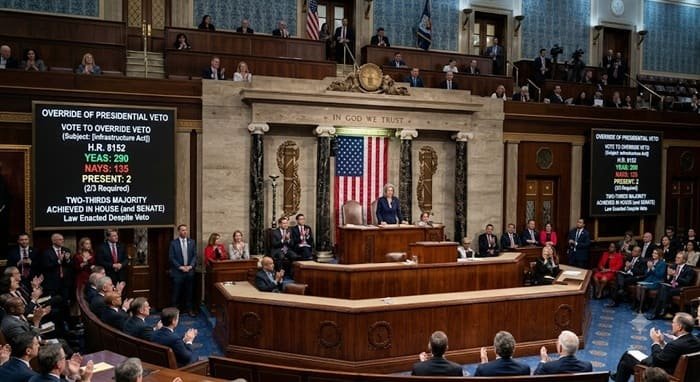
Yes. Congress can make a bill into law without the president’s approval in several ways. The president plays an important role in the lawmaking process, but the Constitution gives Congress ways to act without a signature, and some actions, such as proposing a constitutional amendment, don’t involve the president at all.
The Normal Route: A Bill Goes to the President
Under Article I, Section 7 of the Constitution, a bill must pass both the House of Representatives and the Senate in identical form and then be presented to the president. At that point, the president has three options:
- Sign it, and the bill becomes law.
- Veto it, returning it to Congress with objections.
- Do nothing.
The third option matters. If the president neither signs nor vetoes a bill, it becomes law without a signature after 10 days, not counting Sundays, as long as Congress is in session. In that case, the president has no say in whether the bill takes effect.
Overriding a Veto
If the president vetoes a bill, Congress can still make it law. The House and Senate must each approve the bill again by a two-thirds vote to override the veto, and once both chambers reach that threshold, the bill becomes law despite the veto. The threshold is two-thirds of members present and voting with a quorum, not two-thirds of the full membership. The president doesn’t get a second chance to reject the same measure.
Overrides are uncommon. Of the roughly 2,500 presidential vetoes in US history, Congress has overridden about 100, a rate of around 4 percent. Because the two-thirds requirement is so high, presidents often veto bills when they believe supporters lack the votes to override. A credible veto threat can also lead lawmakers to change a bill before it reaches the president’s desk.
Recent history reflects how hard it is. President Trump has issued two vetoes since taking office in January 2025, and both override efforts failed, even though more than 20 Republicans voted against the president’s position on each. That shows the pattern: a bill can have majority support, even bipartisan support, and still fall short of two-thirds in both chambers.
The Pocket Veto Exception
There is one situation where Congress can lose without a vote. A pocket veto occurs when Congress adjourns within the 10-day window, so the bill can’t be returned for reconsideration. The bill then dies, and Congress has no chance to override. The precise limits of the pocket veto, such as what counts as an adjournment, have been disputed between the branches over the years.
Actions Congress Takes Without the President
Some actions don’t go through the president at all:
- Constitutional amendments. Congress can propose an amendment with a two-thirds vote in each chamber, and it then goes to the states. The president has no formal role, and the Supreme Court said so as early as 1798. An amendment takes effect once three-fourths of the states ratify it.
- Internal rules and procedures. Each chamber sets its own rules and manages its own proceedings.
- Impeachment and trial. The House impeaches and the Senate tries impeachment cases, without presidential approval.
- Senate confirmations and treaty approvals. The Senate gives advice and consent on nominees and treaties, although these are not “laws” in the ordinary sense and the president must act too.
- Simple and concurrent resolutions. These express opinions or manage Congress’s business. They don’t go to the president, but they also don’t have the force of law.
What Congress Cannot Do
Congress can’t skip the president’s desk for an ordinary law. A bill that passes only one chamber, or passes both in different forms, is not law. And Congress can’t give the president a “line-item veto” by statute. In Clinton v. City of New York (1998), the Supreme Court held that the president can’t cancel individual parts of a bill after signing it, so the president must accept or reject a bill as a whole.
Why the System Works This Way
The framers designed the process so that no one branch could control lawmaking. The president’s veto checks Congress, and the override power lets a strong supermajority in Congress check the president. Supporters of the veto say it prevents hasty or narrowly supported laws, while critics say it can give one person outsized influence over legislation that most members support. The two-thirds requirement keeps the balance deliberately tilted toward cooperation.
The Bottom Line
Congress can pass laws without the president’s agreement by overriding a veto with two-thirds votes in both chambers, or when the president lets a bill become law by not acting within 10 days. It can also propose constitutional amendments entirely on its own. In practice, though, overrides are rare, so most major laws still need the president’s signature or a broad bipartisan coalition.