The Bureau of Labor Statistics counted 479,480 workplace injury cases involving falls, slips and trips serious enough to cost time away from work in 2024, alongside 844 deaths. That figure covers employees only. Customers, tenants and visitors appear nowhere in it.
Somewhere in that pile of cases sits the most misunderstood object in premises liability, a folding yellow triangle. Most people assume a wet floor sign ends the argument.
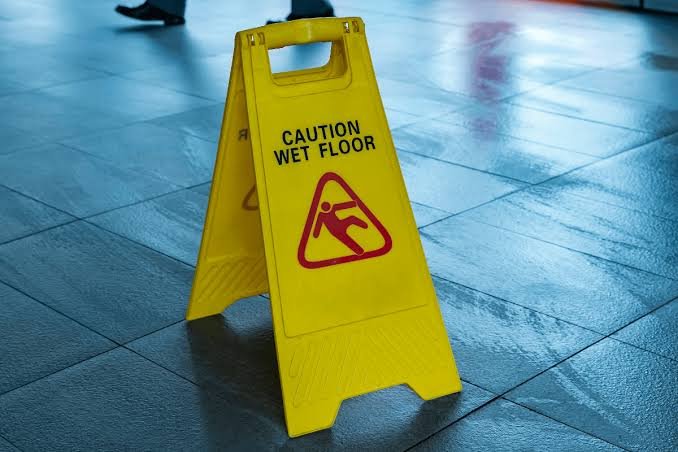
The Sign Is Evidence That Somebody Knew
Notice is usually the whole fight. It’s important for the injured visitor to provide proof that the owner knew about the hazard. Or otherwise, they must show that the property owner found it through reasonable inspection. However, it is reasonably difficult to prove how long a puddle sat on the tile without a video or a sweep log.
A posted sign takes that problem off the table. Somebody saw the spill and walked to a closet for a cone. Actual knowledge is no longer arguable. The dispute moves to what happened after the discovery, which is a much better place for a plaintiff to be standing.
A yellow cone or caution sign doesn’t automatically protect businesses from liability when a slip and fall accident happens. It’s possible to file a wet floor sign lawsuit, but liability depends on the negligence of the property and if the warning was adequate.
Warning Is Not the Same as Fixing
The safety standards make that distinction explicitly. OSHA’s walking-working surfaces standard tells employers to keep floors clean and, to the extent feasible, dry and to keep surfaces free of hazards including leaks and spills. Where a hazard cannot be corrected immediately, the rule says to guard it so nobody uses the surface until the repair happens.
That standard protects employees rather than shoppers, and a violation does not by itself hand a customer a claim. What it does is show what the safety profession treats as a reasonable response to a known hazard. Juries hear that difference clearly, and the gap between blocking an aisle and dropping a cone in it is easy to explain.
So these cases get won and lost in paperwork nobody thinks about at the time. Sweep logs and inspection schedules. Timestamps on store video, which may be overwritten surprisingly quickly. The incident report a manager typed the same night. What the employee holding the mop remembers in a deposition eighteen months later.
Firms that handle this work keep premises liability as their own practice for that reason. SMT Legal, working out of Smithfield Street in downtown Pittsburgh, runs a premises liability practice with a dedicated slip-and-fall section beneath it, and two of its personal injury attorneys, Marissa Andreen and Allison Murray, name premises liability among their focus areas.
Where You Fell Changes the Question Entirely
Most states still sort visitors into categories inherited from old common law. A shopper in a store is an invitee and receives the strongest duty of care. A dinner guest is a licensee and receives less. Pennsylvania still runs those categories. California scrapped them decades ago and applied one duty of ordinary care to everyone lawfully on the property, letting the visibility of a hazard go to fault allocation rather than to whether a duty existed at all.
Fault allocation then differs just as sharply. Pennsylvania cuts off recovery once the injured person carries more responsibility than the defendant. California uses pure comparative fault, so a shopper found 80% responsible can still recover 20% of the damages, assuming the other elements of the claim are established. Same puddle, same cone, two different results.
Open and obvious hazards get treated differently across state lines too. Some courts still let visibility defeat the duty outright. Other states, like California, ask whether the owner should have anticipated that people would encounter the danger anyway. This is exactly what happens when the only route to the exit runs through the wet section.
In these cases, the key issue is often not simply whether a warning sign was present. What you need to prove is whether they have provided an adequate warning. Where is it located, and how long was the spill present? Did the store take additional steps to keep customers away from the hazard?
Evidence addressing these questions may be found in surveillance footage, inspection logs, incident reports, and other records that may only be retained for a limited time. As a result, the presence of a warning cone may be only one part of a much broader investigation into the circumstances of the fall.