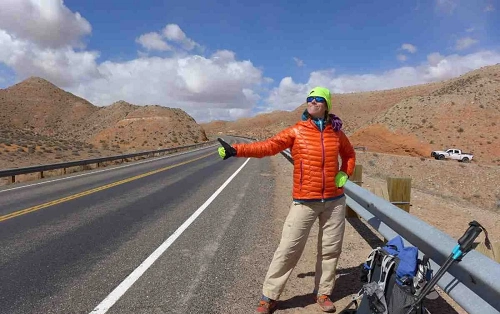
Yes, hitchhiking is legal in Texas, but only when it is done outside the roadway and without interfering with drivers. Texas does not ban the act of soliciting a ride with your thumb or a sign. Instead, the law regulates where a person may stand while doing it, and this is where the rules get complicated. Texas technically defines “roadway” more broadly than most states, and that affects where a hitchhiker may legally stand.
Most Texans assume that standing on the shoulder is legal. In many states it is, but Texas has a unique legal definition that can make that spot illegal for soliciting a ride. At the same time, law enforcement doesn’t always enforce the rule strictly. Understanding the difference between the written law and practical enforcement is key to avoiding tickets.
Texas Law on Hitchhiking Explained
Texas DOES allow you to ask for a ride. The legal limitation is where you stand while asking.
The Primary Hitchhiking Statute
Texas Transportation Code §552.007(a):
“A person may not stand in a roadway to solicit a ride, contribution, employment, or business from an occupant of a vehicle.”
This confirms: Asking for a ride is legal, Standing in a roadway while asking is illegal
So what exactly is a roadway?
Texas Has a Special Definition of “Roadway”
Most states define a roadway as only the part used for driving. Texas normally does too — except when it comes to solicitation.
Texas Transportation Code §552.0071
For the purpose of enforcing solicitation laws, Texas defines “roadway” to include:
- the travel lane
- the shoulder
- the median
- curbs and safety zones
- sidewalks near the road
- utility easements near the road
What this means
Standing on the shoulder to hitchhike can technically be illegal in Texas, because the shoulder is treated as part of the roadway only for solicitation enforcement.
This is the major update missing in most online explanations.
Legal vs. Practical Enforcement
Although the statute could make shoulder hitchhiking illegal, Texas law enforcement typically focuses on whether the person creates a danger. Most police officers:
- do not ticket someone safely off the traffic lane
- do ticket someone stopping vehicles in unsafe places (especially on high-speed highways)
Practical Reality
If you solicit from the grass or dirt area beyond the shoulder, enforcement is extremely unlikely.
When police will step in
- You are too close to traffic
- Drivers must stop abruptly to pick you up
- You stand on a high-speed highway where pedestrians are prohibited
Police generally prioritize safety over technical wording.
Where Hitchhiking Is Clearly Illegal in Texas
Regardless of wording, several locations are always illegal:
Interstates & Controlled-Access Highways
Pedestrians are banned. Hitchhiking here is automatically illegal.
Toll roads & turnpikes
Stopping is prohibited except for emergencies.
Construction zones & bridges with pedestrian bans
If walking there is illegal, hitchhiking is illegal.
Soliciting from the shoulder if unsafe
Even if technically allowed elsewhere, unsafe shoulder solicitation leads to citation.
Where Hitchhiking Is Usually Allowed
Safest legal spots
- Dirt or grass beyond the shoulder
- Sidewalks where pedestrians are permitted
- Exit ramps where drivers can pull off safely (but NOT standing on the shoulder itself)
Driver rules
A driver can legally pick up a hitchhiker only if they pull off the road legally and safely.
Stopping illegally can get the driver cited even if the hitchhiker did nothing wrong.
Penalties for Illegal Hitchhiking
Violations of §552.007 are typically Class C misdemeanors (like a traffic ticket), which may include:
- a fine (usually $75–$300)
- a warning or order to move
Serious danger or obstruction can lead to:
- disorderly conduct charges
- reckless conduct investigations
Final Note
Yes, hitchhiking is legal in Texas in 2025, but only when done outside the roadway. Due to Texas’s special definition of “roadway,” the shoulder may count as a prohibited area for solicitation. Practically, police enforce the rule based on safety, not strict wording. Hitchhikers who stand beyond the shoulder (grass or dirt areas) are usually safe legally, while those standing in traffic lanes, on shoulders of high-speed highways, or in banned pedestrian zones risk citations.