In Texas, gerrymandering is legal in the sense that the Legislature can draw maps that favor one party, so long as they do not cross the line into racial discrimination.
Texas lawmakers do legally redraw district boundaries with partisan intent. But there are legal limits: maps that discriminate on the basis of race or violate federal protections are unlawful. So it’s legal to favor a party; it’s illegal to target minority voters because of race. Texans should understand the distinction, the pending lawsuits, and what the limits mean for politics.
What the Law Says About Gerrymandering in Texas
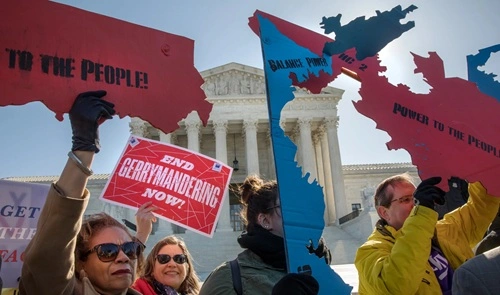
- Under U.S. law, the Supreme Court has held that racially motivated redistricting(where race is the predominant factor) violates the Equal Protection Clause and the Voting Rights Act of 1965 (VRA).
- By contrast, the Court has found that purely partisan gerrymandering(drawing maps to benefit a political party without racial discrimination) is not per se unconstitutional under federal law.
- In Texas, the state redistricting law requires maps to meet population equality, not intentionally discriminate based on race, and comply with federal and state constitutional norms.
What Happens in Texas Right Now (2025)
- Texas lawmakers in 2025 approved a mid-decade redistricting map for congressional districts with ties to partisan strategy.
- Legal challenges are already underway. Civil-rights groups allege the newly drawn maps dilute minority voting power and thus amount to unconstitutional racial gerrymandering under the VRA.
- So far, no final court decision has declared all partisan gerrymandering illegal in Texas — the legal fight continues.
What Texas Residents Can and Cannot Do (or Expect)
What is allowed
- The Texas Legislature may legally redraw electoral districts (for the House, Senate, Congress) to reflect changes in population or political strategy — so long as they follow legal requirements.
- Political parties may benefit from redraws that produce favorable majorities for their candidates, provided race is not the predominant motive.
What is not allowed
- Drawing districts primarily to dilute the voting strength of racial or language-minority groups is illegal under the Voting Rights Act and federal courts.
- Maps that appear to use race as the dominant factor (even if also partisan) are subject to being overturned by courts.
- Ignoring equality of population and other map-drawing requirements may also trigger a court challenge.
Why the Distinction Matters
- Because partisan gerrymandering is not outright banned by the U.S. Supreme Court, Texas’ redistricting efforts that advantage one party are likely legal — unless they are shown to violate racial protections or other constitutional benchmarks.
- The difference between “We drew this map to help our party” and “We drew this map to target voters of color” is legally significant. The latter triggers the stricter standard.
- For individual voters, the legality of a map may affect their district, representation, and whether a map can be challenged in court.
What Texans Should Be Aware Of
- If you believe your district has been drawn unfairly, check if the issue is about race(potentially illegal) or just partisan advantage (likely legal under current federal case law).
- Court decisions in 2025 may change the landscape — Texas is facing important litigation right now that could affect future maps.
- Even legal maps may feel unfair to voters, so being aware of the redistricting process, hearing opportunities, and public input is valuable.
- Participation matters: public hearings, map-drawing transparency and community advocacy can affect how districts are created.
Final Take
The key legal dividing line is not partisan bias itself, but whether race was used as a predominant factor in drawing the map. Because Texas is undergoing major redistricting and litigation now, the maps you vote under could change — and so could the law governing them. If you’re tracking representation, district lines or fairness, this is a moment to pay attention.