No, muffler deletes are not legal in Texas. State law requires a motor vehicle to have a functioning muffler and prohibits using cut-outs, bypasses or straight-pipe setups that remove or disable required exhaust equipment.
What the Law Says
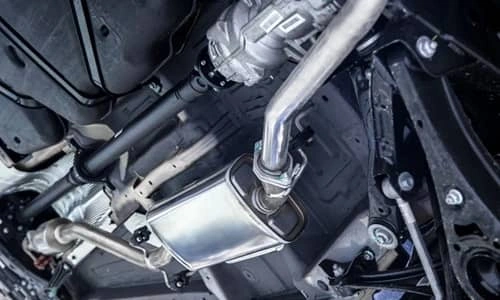
Under Texas Transportation Code §547.604 (the state statute), every motor vehicle must be equipped with a muffler in good working condition that continuously operates to prevent “excessive or unusual noise.” It also explicitly prohibits the use of a “muffler cut-out, bypass, or similar device.”
In practical terms, that means if you remove the muffler (i.e., perform a muffler delete) and either the noise becomes “excessive or unusual,” or you remove or disable required exhaust emissions or noise control components, you are violating Texas law.
What Counts as an Illegal Modification
Some specific modifications that fall outside of legal bounds include:
- Removing the muffler altogether so there is no device to reduce noise.
- Installing a “straight pipe” where the muffler (and sometimes catalytic converter) is removed so the exhaust is wide open.
- Using a muffler cut-out or bypass mechanism that allows you to switch between muffler/no muffler while driving.
- Producing exhaust noise that is clearly louder or more disruptive than what the statute considers “normal.” The law doesn’t specify a decibel limit statewide, but it leaves room for enforcement if noise is “excessive or unusual.”
What About Aftermarket Exhausts?
Not all modifications to the exhaust are illegal. Texas allows aftermarket exhaust systems so long as they comply with the law’s requirements:
- The vehicle still must have a working muffler.
- The exhaust system must be in good working condition with no parts missing or disabled that are required by law (especially in counties that do emissions inspections).
- The noise level cannot be “excessive or unusual,” even though the statute doesn’t define exact decibel thresholds for all vehicles. Some local jurisdictions may have their own noise ordinances.
So you can install a performance exhaust system — but you can’t simply delete the muffler and make the car intolerably loud, and you can’t remove key components tied to noise and emissions control.
Reasons Why the Law is Written This Way
There are a few reasons why Texas law takes this stance:
- Noise control & public welfare: Mufflers exist to reduce noise, which otherwise can become a disturbance in neighborhoods, near roads, and in urban settings.
- Safety & emissions: The exhaust system often ties into emissions controls and proper routing of exhaust gases. Removing components may lead to increased pollution or safety hazards (e.g., hot gases or flames exiting where not intended).
- Local enforcement: While Texas doesn’t set a strict statewide decibel limit in many cases, the “excessive or unusual” language gives law enforcement and local jurisdictions a tool to enforce based on disturbance or unsafe conditions.
What You Should Do Before Modifying Your Exhaust
If you’re thinking about modifying the muffler or exhaust on your vehicle in Texas, these are good steps:
- Check your vehicle’s existing exhaust system: Make sure all required components (muffler, catalytic converter if applicable, emissions controls) are present and operational.
- Review state law and local ordinances: While §547.604 gives the base requirement, your city or county may add noise-control ordinances or emissions inspection rules.
- Choose a legal aftermarket system: Select one that retains a working muffler and doesn’t disable emissions equipment.
- Avoid going too extreme with noise: Even if your system passes inspection, if it is deemed “excessive or unusual” you could be cited.
- Keep documentation: If you install an aftermarket system, keep receipts, details on the system, compliance statements, or certification where available in case you are stopped or inspected.
Final Note
No, muffler deletes are not legal in Texas. The law mandates that your vehicle must have a working muffler and prohibits flush removal or disabling of that muffler, bypasses or similar devices. While aftermarket exhaust modifications are allowed, they must preserve the muffler and meet the “good working condition” test. If you are unsure about your specific vehicle or local jurisdiction, it’s wise to consult a qualified mechanic or local law enforcement for your city or county.