A workplace injury does not always fit neatly into the employee-or-contractor box. The real question is often how the relationship worked in practice, what insurance was in place, and which state’s law applies.
Independent work is no longer a niche arrangement. In July 2023, the U.S. Bureau of Labor Statistics counted 11.9 million independent contractors in their main or sole job, equal to 7.4% of total U.S. employment. In 2017, the comparable figure was 6.9%.
That growth has made an old legal question more common: what happens when someone gets hurt on the job but the company calls that person an independent contractor?

There is no single nationwide answer. The contract matters, but so does the way the work was actually performed. State law, insurance arrangements, and the degree of control exercised by the hiring business may all affect whether workers’ compensation is available — or whether another type of claim makes more sense.
Workplace injuries are still a major risk
Private-industry employers reported about 2.5 million nonfatal workplace injuries and illnesses in 2024, according to the BLS Survey of Occupational Injuries and Illnesses. The total recordable case rate was 2.3 cases per 100 full-time-equivalent workers.
That figure has an important limitation for this discussion: the BLS survey does not include self-employed workers. So the main federal dataset on nonfatal workplace injuries leaves out many people who work for themselves, including a large share of independent contractors.
Fatality data give a broader view. In 2024, the BLS recorded 5,070 fatal occupational injuries nationwide. Of those, 888 involved self-employed workers and 4,182 involved wage-and-salary workers. “Self-employed” is a broader category than “independent contractor,” so those numbers should not be treated as a contractor death count. They do show, however, that serious workplace hazards are not limited to traditional employees.
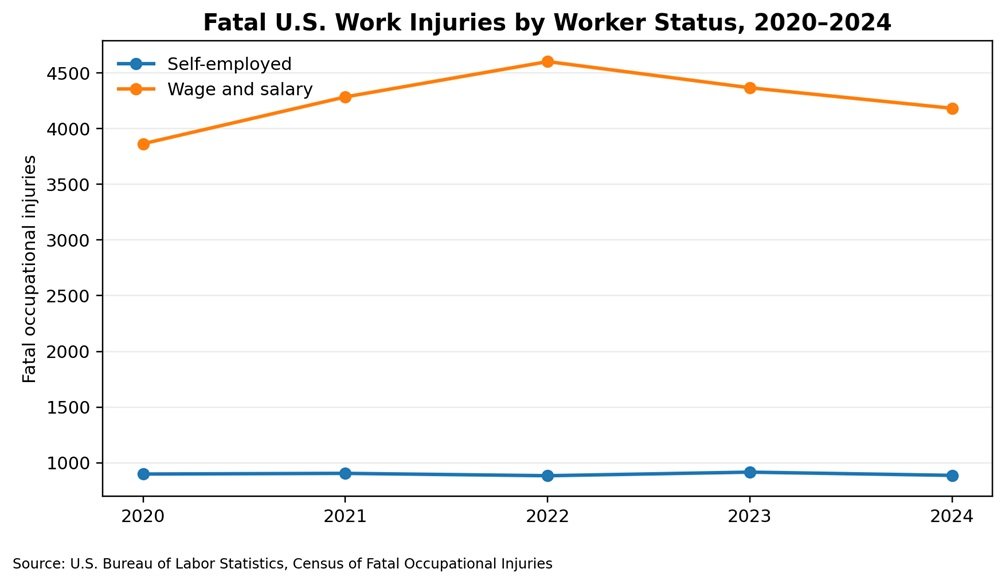
Figure 1. Fatal U.S. occupational injuries by employee status, 2020–2024. Source: U.S. Bureau of Labor Statistics
Why the label matters — and why it may not be decisive
Workers’ compensation is built mainly around the employer-employee relationship. A covered employee generally does not need to prove that the employer was negligent in order to receive benefits for a qualifying work injury. Medical care and partial wage replacement are among the benefits that may be available, depending on the state.
Independent contractors are usually treated differently. In Texas, the Texas Department of Insurance Division of Workers’ Compensation explains that an independent contractor is generally not an employee under the Texas Workers’ Compensation Act. But classification can still turn on the facts, including who had the right to control the details of the work.
That is why a contract describing someone as an “independent contractor” is important, but not always the end of the analysis. If the day-to-day reality looks more like an employment relationship, the classification may be challenged.
What does the working relationship actually look like?
When worker status is disputed, lawyers and agencies often look beyond the paperwork and examine how the relationship functioned in practice. Questions may include:
- Who decided when and where the work had to be done?
- Who controlled the methods used to complete the job?
- Who supplied the tools, equipment, or materials?
- Was the worker free to take jobs from other businesses?
- Was payment tied to a project, or did it resemble regular payroll?
- Did the worker operate a genuinely independent business?
- How closely did the hiring company supervise the work?
No single question necessarily decides the issue. What matters is the overall relationship and the legal test used in the state where the claim arises.
When workers’ compensation may still come into play
Misclassification
Consider a construction worker who is called an independent contractor but works almost entirely for one company. The company sets the schedule, tells the worker how to perform the job, provides important equipment, and closely supervises the work. Those facts may not line up neatly with the label in the contract.
The exact test varies from state to state. Someone researching workers’ compensation for independent contractors in Georgia, for example, will find rules that focus on the actual relationship and the level of control involved. The larger point is simple: a 1099 form or a contract heading does not always settle worker status by itself.
Coverage created by agreement
Some contractor relationships include workers’ compensation coverage by agreement. Texas workers’ compensation rules address arrangements between hiring contractors and subcontractors, including written agreements that can affect who is treated as the employer for coverage purposes. The relevant provisions are set out in the Texas workers’ compensation rules.
For contractors, this is a good reason to check insurance arrangements before work begins. Coverage may exist even when the worker assumes it does not — or the contract may place the responsibility elsewhere.
A contractor’s own policy
Independent contractors can also purchase their own coverage. The Texas Department of Insurance consumer guide explains the basic role of workers’ compensation insurance, including medical benefits and partial wage replacement for qualifying injuries. In some industries, carrying a policy is also a contractual requirement for subcontractors.
Texas has its own wrinkle: employers can opt out
Texas is unusual because most private employers are not required to carry workers’ compensation insurance. The Texas Department of Insurance says private employers may choose whether to provide coverage, while governmental entities must carry it. Employers that buy coverage are often called subscribers; those that do not are known as non-subscribers.
For covered employees, the Division of Workers’ Compensation says workers’ compensation can pay medical bills and replace part of lost income after a qualifying work-related injury or illness.
For an injured contractor, that means the first questions are often practical ones: Did the hiring business have workers’ compensation insurance? Was the injured person truly an independent contractor under the law? Was there a written agreement dealing with coverage? And did someone else — another contractor, a property owner, a driver, or an equipment manufacturer — contribute to the accident?
Sometimes the better route is a personal injury claim
A contractor who is not entitled to workers’ compensation may still have a claim if another person or business caused the injury through negligence. That could happen when defective equipment fails, another driver causes a crash, a property owner leaves a dangerous condition unaddressed, or another contractor creates a hazard on a shared jobsite.
The legal framework is different. Workers’ compensation is generally a no-fault system for covered employees. A personal injury case usually requires proof that another party owed a duty, breached it, and caused the injury. The categories of compensation available may also be different.
What an injured contractor should save
When classification or responsibility may be disputed, early documentation can make a real difference. Useful records include:
- The contract, amendments, work orders, and scope-of-work documents
- Invoices, payment records, and tax documents
- Schedules and instructions from supervisors or project managers
- Texts, emails, or app messages showing how the work was directed
- Photos or video of the scene, equipment, and surrounding conditions
- Witness names and contact information
- Safety policies, training records, and incident reports
- Records showing who supplied the tools and equipment
- Medical records tying the injury to the workplace event
The details that seem routine before an accident — who gave instructions, who supplied equipment, whether the worker could turn down assignments — can become important later if the company and worker disagree about the nature of the relationship.
A job title is only the starting point
Independent contracting is now a significant part of the U.S. workforce, but the legal protections available after an injury are not always obvious. Federal injury data themselves illustrate the gap: millions of people work as independent contractors, yet the country’s main survey of nonfatal occupational injuries excludes the self-employed.
For someone injured while working, the safest assumption is not that “independent contractor” automatically means “no workers’ compensation.” The answer may depend on the real working relationship, the insurance in place, any written coverage agreements, and the law of the state where the injury occurred.
Those details determine whether the next step is a workers’ compensation claim, a third-party injury case, another insurance claim, or some combination of available remedies.
Editorial note: This article provides general legal information and is not legal advice. Workers’ compensation and worker-classification rules vary by state and by the facts of each working relationship.