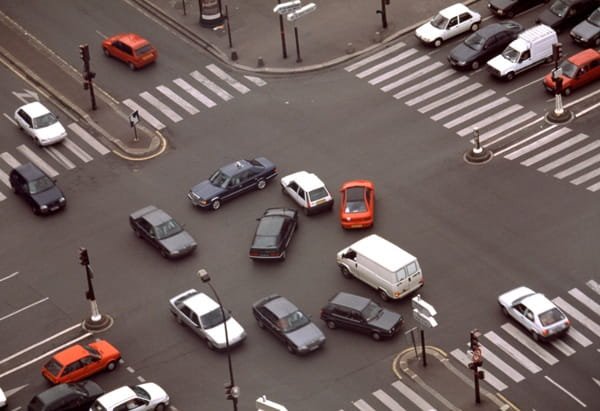
Intersections are where California crashes concentrate. Two streams of traffic, turning vehicles, pedestrians and red-light runners all meet in one box of pavement.
Studies built on the California Highway Patrol’s Statewide Integrated Traffic Records System (SWITRS) show the same pattern year after year. The worst intersections cluster in Southern California, and Los Angeles leads by a wide margin.
Here’s what the data shows, city by city, and what changes when an 80,000-pound truck is in the mix.
The Statewide Picture
One statewide SWITRS analysis reviewed more than 435,000 collision records. It ranked 444 intersections as the most dangerous in California, covering 7,294 crashes, 7,478 injuries and 57 deaths.
The geographic split was lopsided:
- Los Angeles had 221 of the 444 intersections, nearly half.
- Sacramento came in a distant second, with 13.
- More than 90% of the dangerous intersections were in Southern California.
City-by-City Hot Spots
Los Angeles: Figueroa Street and Slauson Avenue. LAPD data from 2021 to 2025 put this South LA intersection at the top of the city’s list, with 66 crashes. Figueroa and Manchester ranked third with 61. Roscoe and Van Nuys (59) and Western and Slauson (56) rounded out the top five.
Fullerton: Euclid Street and Orangethorpe Avenue. An Orange County study covering nine years of data found 72 crashes and 74 injuries at Euclid and Orangethorpe. That made it the most dangerous intersection in Fullerton and second in the county. Fullerton held 18 of the county’s 50 most dangerous intersections.
San Jose: McLaughlin Avenue and Story Road. This was the most dangerous San Jose intersection from 2013 to 2017. Capitol Avenue and Capitol Expressway was the deadliest, with two fatalities.
Santa Clarita: Sierra Highway and Soledad Canyon Road. Seven Santa Clarita intersections made the statewide list, and this one led the city.
Santa Cruz: Highway 1 and Highway 9. It topped Santa Cruz’s list for 2020–2024. Pacific Avenue and Beach Street ranked second.
What These Intersections Have in Common
- Multi-lane arterials. Figueroa, Harbor Boulevard and Capitol Expressway all carry high-speed, high-volume traffic.
- Unprotected left turns. Drivers misjudge gaps in oncoming traffic, especially across three or more lanes.
- Mixed traffic. Pedestrians, buses and commercial trucks share the same signal cycle.
- Expressway-style design. Roads built for throughput, not for crossing.
Why Trucks Change the Math
Put a loaded tractor-trailer into any of these intersections and the risk profile shifts:
- Stopping distance. A fully loaded big rig needs far more room to stop than a passenger car. A truck that misjudges a yellow light runs the red.
- Wide right turns. Trailers swing left before turning right, which opens a gap that drivers and cyclists move into. The trailer then sweeps across it.
- Blind spots. Trucks have large no-zones on all four sides. A car stopped beside a trailer at a light is often invisible to the driver.
- Severity. When a truck strikes a passenger car broadside, the occupants of the car absorb nearly all of the force.
Outside Los Angeles, California’s busiest truck corridors run through the Central Valley. Highway 99, Interstate 5 and Highway 58 move freight through Bakersfield, Fresno and Visalia. The surface-street intersections near distribution centers and on- and off-ramps see heavy rig traffic every day.
Why Commercial Truck Crash Claims Require a Different Investigation
A commercial truck accident involves more than determining which driver caused the collision. Liability extends beyond the driver when a trucking company’s scheduling practices, improper cargo loading, or neglected vehicle maintenance contributed to the crash. Federal Motor Carrier Safety Administration (FMCSA) regulations establish requirements for driving hours, vehicle inspections, maintenance, and recordkeeping.
Those records help establish what happened before a truck entered a Bakersfield intersection. Electronic logging device data shows driving hours, inspection reports document vehicle conditions, and dispatch communications reveal instructions given to the driver. Each record answers a different liability question. Retention periods vary, and electronic footage is vulnerable to routine overwriting.
The investigation also extends beyond the crash location. A truck involved in a collision on Highway 99 might belong to a carrier based in another county, carry freight loaded elsewhere, and have maintenance records held by a separate contractor. Identifying those parties and securing their records requires examining the entire trucking operation, not just the accident scene. This is the type of multi-party investigation handled by May Firm’s California truck accident lawyers, whose practice extends from Bakersfield and Fresno to Visalia, Long Beach, and Chula Vista. Early evidence preservation establishes the records needed to determine each party’s responsibility.
California Dangerous Highways
The most dangerous intersections in California share the same design flaws: wide roads, unprotected turns and mixed traffic. Add a commercial truck, and a fender-bender becomes a catastrophic injury. Drive these intersections defensively. If a truck hits you, move fast to protect the evidence.