Yes, OTF (out-the-front) knives are legal in Texas, but you still have to follow the rules about blade length and where you carry them. Texas changed its knife laws a few years ago, and those changes removed most of the old restrictions that used to confuse people. Today, the law doesn’t care whether the blade opens with a spring, a button, or by gravity. What really matters is the size of the blade and the place where you’re carrying it.
OTF knives were once treated as suspicious or “switchblade-type” weapons in some states, but Texas took a different direction. The state decided to simplify things and put all knives into the same basic category, which makes it easier for regular people to understand what’s allowed. That means adults in Texas can buy, own, and carry an OTF knife openly or concealed as long as they respect the location rules that apply to all larger knives.
So yes, OTF knives are legal, but you need to know the boundaries so you don’t accidentally break a law without realizing it.
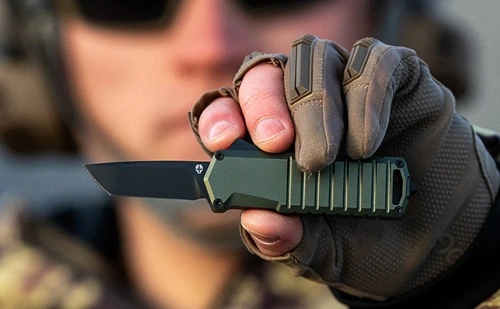
What the Law Actually Says
Texas removed the old “illegal knife” category through House Bill 1935 (effective 2017). Instead of banning knife types, the law now focuses on:
- Blade length, and
- Specific locations where larger knives are not allowed.
Under the Texas Penal Code:
- A knife is any bladed instrument capable of causing serious injury.
- A location-restricted knife is any knife with a blade over 5½ inches.
OTF knives are not banned by design. They fall under the same rules as any other knife. The only thing that matters is whether the blade is over or under 5½ inches.
How Texas Measures Blade Length (Important Clarification)
The law sets the limit at over 5½ inches, but it doesn’t describe exactly how to measure a blade. Texas courts and industry standards follow a common, widely accepted method:
1. Measure a straight line from the tip to the start of the handle.
Not the curve of the blade — just the shortest straight line.
2. The unsharpened part still counts.
Areas like a choil, ricasso, or flat sections before the edge starts are part of the blade for legal measurement.
3. For OTF knives:
Measure from the blade tip back to the inner lip of the handle opening where the blade comes out.
That’s considered the forward-most point of the handle.
Why it matters
Some OTF designs make the sharpened edge look short, but legally, the whole blade counts. If this measurement goes past 5½ inches, the knife becomes a location-restricted knife even if the cutting edge is shorter.
Where You Can and Cannot Carry an OTF Knife
If your OTF knife has a blade 5½ inches or less:
You can carry it almost anywhere besides obvious weapon-restricted zones.
If your OTF knife has a blade over 5½ inches:
You cannot carry it in certain places, including:
- School grounds
- School events
- Courthouses
- Polling places during elections
- Secured airport areas
- Some government offices
- Certain bars that get most income from on-premises alcohol sales
Minors (under 18) also cannot carry a location-restricted knife unless an exception applies.
Practical Examples
- 3-inch OTF knife: Legal to carry, no special restrictions besides weapon-free zones.
- 6-inch OTF knife: Legal to own and carry in many areas, but prohibited in restricted locations.
- OTF knife at a courthouse: Even if under 5½ inches, it may be restricted because the location bans weapons altogether.
- OTF knife with intent to threaten someone: Illegal, regardless of blade length — intent matters.
Final Word
So again Yes, OTF knives are legal in Texas, but always pay attention to the blade length and the location you’re carrying it in. Texas has some of the most relaxed knife laws in the country, but the state still protects certain places like schools, courts, and voting locations. As long as you understand those restrictions, carrying an OTF knife in Texas is completely within the law.